
Does it feel like your sock is bunched up under the ball of your foot, or do you experience sharp, electric-shock sensations between your toes? These are the hallmark signs of Morton’s Neuroma and Metatarsalgia. At Podiatry Quest, we specialise in identifying the exact mechanical cause of your forefoot pain. By using advanced MSK assessments and precision offloading, we help Singapore’s active professionals and runners return to their feet pain-free.
Morton’s Neuroma & Metatarsalgia Treatment
Stop feeling like you're walking on a pebble. Our specialist musculoskeletal approach decompress the nerves and restores comfort - without surgery.


About Morton's Neuroma & Metatarsalgia
Understanding Your Forefoot Pain
Many patients group all “ball of foot” pain together, but effective treatment requires a specific diagnosis. Metatarsalgia is an umbrella term for pain in the forefoot, while Morton’s Neuroma specifically involves the thickening and irritation of the nerve tissue leading to your toes (most commonly between the third and fourth toes).
Our clinical team differentiates between these two common conditions:
- Metatarsalgia (The “Bruise”): This is irritation of structures in your forefoot such as your metatarsal joints. . It feels like a dull, localised ache or a “stone bruise” that worsens when you are barefoot or on hard floors.
- Morton’s Neuroma (The “Nerve”): This is a thickening of the tissue surrounding the digital nerve (usually between the 3rd and 4th toes). It presents as burning pain, numbness, or a distressing “electric” tingling that radiates into the toes.
Left untreated, nerve compression can lead to permanent numbness. Early intervention is the key to avoiding invasive injections or surgical neurectomy.
A Deep-Dive Musculoskeletal Assessment
We don’t just provide a cushion; we provide a cure. Our diagnostic process is built on clinical precision:
- Mulder’s Click Test: Morton’s Neuroma occurs when the nerves leading to your toes are compressed, irritated, or injured. Our podiatrists perform this specialised manual test to physically palpate and “click” the neuroma gently, confirming its presence and size.
- Digital Palpation & Squeeze Testing: We assess the “forefoot splay” to see if your metatarsal bones are collapsing together and “pinching” the nerve. Individuals with bunions, hammertoes, or excessively wide feet are at higher risk due to shoe fit issues.
- Gait Analysis and Biomechanical Assessment: We analyse your “toe-off” phase. If you are putting too much pressure on your forefoot during walking, this could be caused by tight calf muscles and poor foot function.
- Clinical Shoe Audit: Bring your work shoes and trainers. We check for a narrow toe-box or lack of “torsional stiffness” that may be the primary driver of your nerve irritation.
How We Help
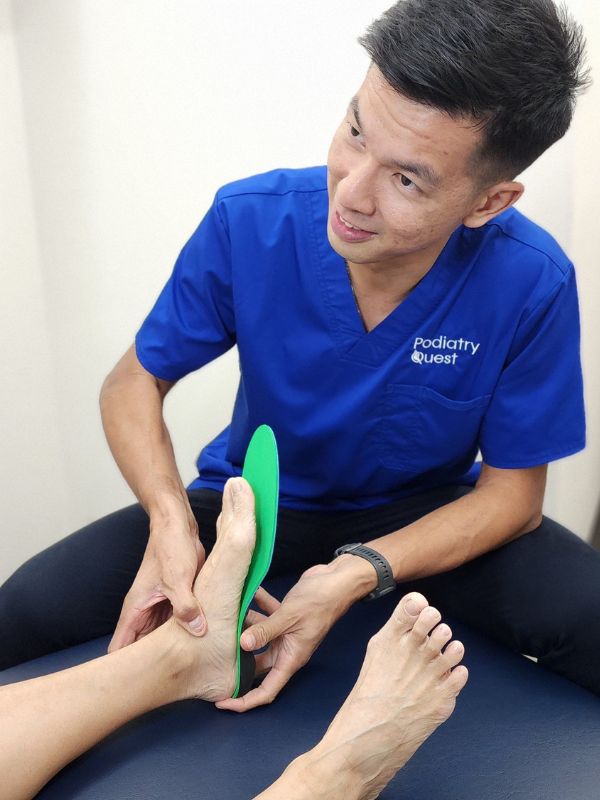
How Podiatry Quest Helps You Recover
We focus on conservative, highly effective treatments to resolve your pain so you can avoid surgery. Our goal is to create space within your foot to allow the nerve to “breahteYour customised treatment plan may include:
- Shockwave Therapy: We use advanced acoustic sound waves directed at the painful area to reduce nerve inflammation, decrease pain sensitivity, and accelerate your body’s natural healing process.
- Customised Foot Orthotics: We prescribe precision-made insoles designed for your unique biomechanics. By contouring your heel and arch, and utilising targeted metatarsal pads, our orthotics deflect pressure away from the irritated nerve.
- Footwear Prescription: We analyse your lifestyle and biomechanics to recommend the perfect wider, softer, and lower-heeled shoes for both indoor and outdoor use. Many fashionable shoes have narrow toe boxes that “squeeze” the nerve – we help you find stylish alternatives that protect your feet that are “nerve” friendly.
- Targeted Mobility Exercises: We will guide you through specific exercises, such as calf stretches, to improve flexibility and reduce walking pressure on your forefoot.
(Note: In rare cases where symptoms do not respond to long-term conservative care, we can advise on further medical interventions).
“I had a persistent burning sensation in the ball of my foot that made running impossible. The podiatrist did a very thorough check and the insoles they designed have completely offloaded the pressure. Finally walking pain-free!” – Jason Low
“I’ve been dealing with persistent foot pain for a while, especially after long hours on my feet. After a detailed assessment and getting my custom 3D orthotics, the pain has subsided significantly and walking feels much more stable now.” – Marcus C
Walk Without the “Electric Shock”
Forefoot pain is progressive. Every step you take on an inflamed nerve makes recovery longer. Take the first step toward permanent relief today.
Specialist care available at Holland Grove, Novena, Harbourfront, Raffles Place and Tampines. Let’s get you back on your feet.
Frequently Asked Questions: Morton’s Neuroma & Metatarsalgia
Why does it feel like there is a pebble in my shoe?
That “phantom pebble” is actually a hallmark symptom of Morton’s Neuroma. This occurs when a nerve in the ball of your foot becomes thickened and inflamed. Even when your shoe is completely empty, it can feel like you are walking on a stone or as if your sock is perpetually bunched up under your toes.
Can Morton's Neuroma be treated without surgery?
Absolutely. Most cases of Morton’s Neuroma and Metatarsalgia respond remarkably well to non-surgical interventions. Our clinical goal is to decompress the nerve naturally. We achieve this through a combination of custom 3D-printed orthotics, metatarsal offloading techniques, and strategic footwear changes, and shockwave therapy allowing the inflammation to subside without invasive procedures.
Do I need wide shoes for Morton's Neuroma?
A wider toe box is often essential for recovery. Narrow shoes squeeze the metatarsal bones together, which further pinches the already inflamed nerve. During a consultation, we provide a “shoe audit” to help you identify footwear that offers enough space for your toes to splay naturally without sacrificing the style or professional look you need.
Visit Us
All are welcome!
Podiatry Quest – Holland Grove
- 24 Holland Grove Road, Parksuites, #01-07, Singapore 278803
- Call: (+65) 6027 2389
- Whatsapp: (+65) 8333 9643
- View On Google Maps
Appointment basis; please reach out!
We are situated in a mixed-used estate called Parksuites. There is on-site parking if required.
Bus 92 from Buona Vista MRT.
Monday: Closed
Tuesday: 9am – 8pm
Wednesday: 9am – 6pm
Thursday: Closed
Friday: 9am – 6pm
Saturday: 1230pm – 430pm
Sunday & Public Holidays: Closed
Podiatry Quest – Novena
- 238 Thomson Rd, #03-32, Novena Square, Singapore 307683
- Call: (+65) 6027 2389
- Whatsapp: (+65) 8333 9643
- View On Google Maps
Appointment basis; please reach out!
The clinic is located on level 3 Novena Square, down a corridor right opposite the lifts.
Monday: Closed
Tuesday: Closed
Wednesday: 10am – 7pm
Thursday: 9am – 6pm
Friday: Closed
Saturday: 9am – 1pm
Sunday & Public Holidays: Closed
Podiatry Quest – Raffles Place
- 6 Raffles Quay, #11-01, Singapore 048580
- Call: (+65) 6027 2389
- Whatsapp: (+65) 8333 9643
- View On Google Maps
Appointment basis; please reach out!
We are next to Hong Leong building. There is on-site parking in the building if required.
Monday: 9am – 6pm
Tuesday: Closed
Wednesday: 9am – 6pm
Thursday: Closed
Friday: Closed
Saturday: Closed
Sunday & Public Holidays: Closed
Podiatry Quest – Harbourfront
- 1 Maritime Square, #09-10, Harbourfront Centre, Singapore 099253
- Call: (+65) 6027 2389
- Whatsapp: (+65) 8333 9643
- View On Google Maps
Appointment basis; please reach out!
Lift lobby B provides easiest access to us
Monday: Closed
Tuesday: 9am – 1pm
Wednesday: Closed
Thursday: 9am – 6pm
Friday: Closed
Saturday: 9am – 1pm
Sunday & Public Holidays: Closed
Podiatry Quest – Tampines
- 3 Tampines Central 1, #04-02, Tampines Plaza 1, S529540
- Call: (+65) 6027 2389
- Whatsapp: (+65) 8333 9643
- View On Google Maps
Appointment basis; please reach out!
Monday: 9am – 6pm
Tuesday: Closed
Wednesday: Closed
Thursday: Closed
Friday: 9am – 6pm
Saturday: Closed
Sunday & Public Holidays: Closed