
An ingrown toenail (onychocryptosis) occurs when the lateral or medial border of the nail plate penetrates the adjacent periungual skin of the nail sulcus. As the rigid edge pierces the periungual tissue, it acts as a foreign body, triggering a cascade of mechanical irritation, sustained inflammation, and localised swelling. Left unaddressed, this compromise of the cutaneous barrier creates an entry portal for opportunistic bacterial pathogens, frequently precipitating secondary infections and hypergranulation tissue.
Ingrown Toenails: Clinical Assessment, Stages, and Treatment Pathways
Don’t suffer in silence. Whether it’s a first-time ache or a recurring infection, we provide sterile, specialist care to get you back on your feet today.

Pathological Triggers in Singapore
While genetic predisposition—such as naturally involuted, pincer, or fan-shaped nail plates—plays a major role, external lifestyle factors common in Singapore routinely accelerate the onset of onychocryptosis:
-
Tropical Humidity and Hyperhidrosis: High ambient heat and humidity soften the stratum corneum (maceration) surrounding the nail plate. Softened sulcus tissues are far more vulnerable to micro-punctures from sharp lateral nail edges.
-
National Service and Occupational Footwear: Prolonged marches and rigorous physical training in rigid combat boots generate substantial repetitive microtrauma. Constricted toe boxes compress the hallux against adjacent digits, forcing the nail sulcus directly against the lateral margin. Similar mechanics affect corporate workers wearing narrow dress shoes or tapered high heels.
-
Repetitive Deceleration Sports: Court and endurance sports—such as badminton, squash, padel, football, and distance running—involve abrupt braking motions. This repeatedly shunts the toes forward into the toe cap, driving lateral nail borders deep into the surrounding tissue.
-
Improper Trimming Techniques: Rounding off nail corners or curving edges down into the lateral gutters leaves an uneven, jagged spur (a spicule). As the nail plate grows distally, this hidden spicule pierces the dermal tissue.
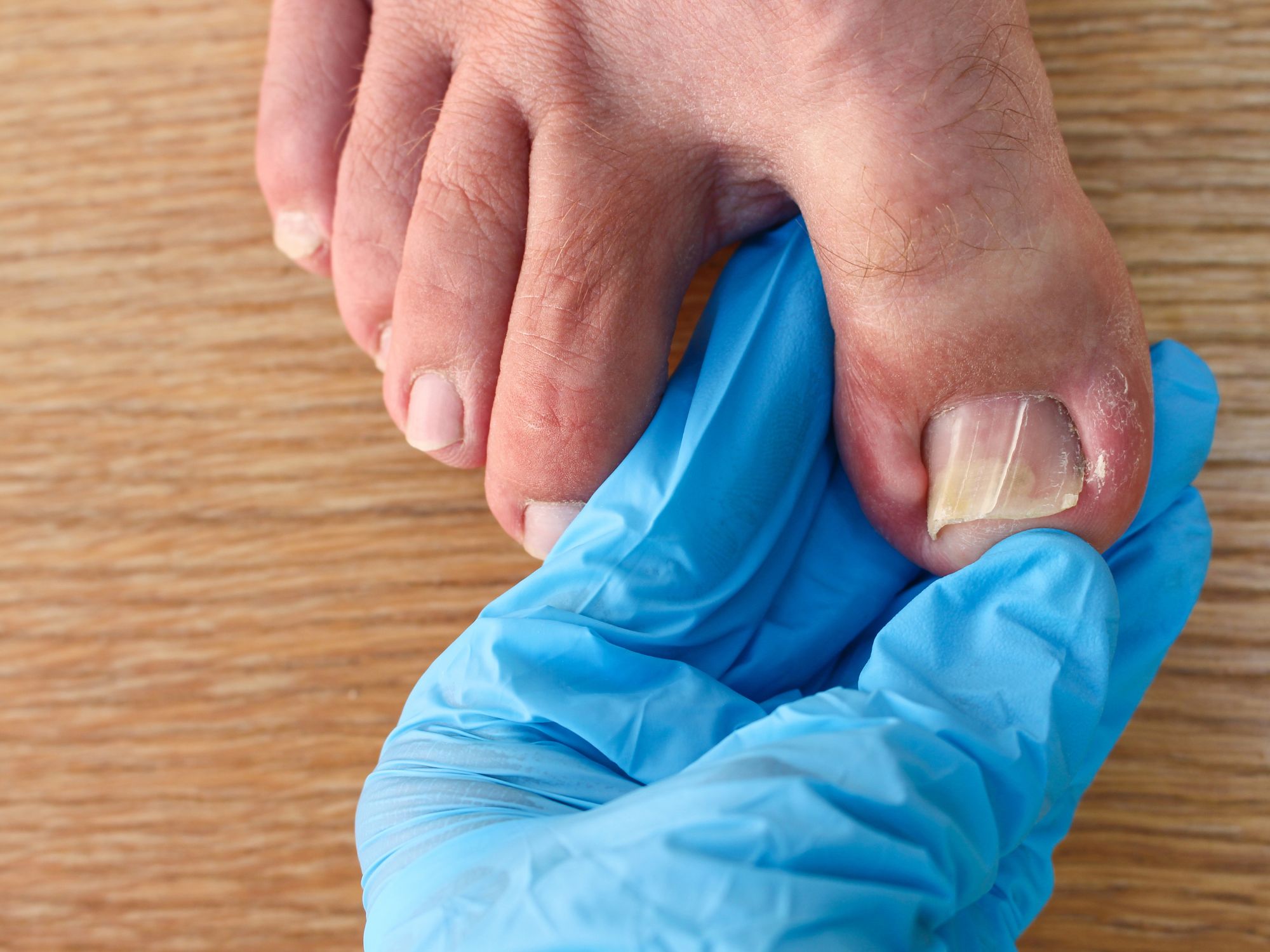
Clinical Stages and Urgent Warning Signs
Onychocryptosis progresses along a distinct clinical spectrum. Early identification prevents permanent tissue hypertrophy and widespread systemic complications.
How We Help

Professional Clinical Assessment: What We Do in Clinic
Resolving onychocryptosis requires identifying both the mechanical insult and underlying systemic contributors. At Podiatry Quest, our diagnostic protocol entails:
-
Sulcus Inspection and Depth Mapping: Using sterile, blunt-ended probes to locate hidden lateral spicules, assess tissue viability, and detect concealed ulcerations or foreign debris.
-
Vascular and Neurological Screening: Palpation of dorsalis pedis and posterior tibial pulses, capillary refill time evaluation, and monofilament sensory testing to ensure safe tissue healing capacity.
-
Biomechanical and Gait Analysis: Evaluating excessive foot pronation, hallux limitus, and gait patterns that place compensatory shear stress across the medial border of the great toe.
-
Microbiological Review: Evaluating purulent exudate to distinguish between active bacterial colonisation and sterile inflammatory reactions.
Why “Bathroom Surgery” Fails
Attempting to dig out offending nail borders at home with nail clippers, tweezers, or razor blades almost universally worsens the condition:
-
Blind Cutting Creates Spicules: Cutting blindly down the curved nail sulcus snaps the nail plate rather than removing it cleanly. This leaves a jagged, spear-like spur deeper in the fold that embeds further as the digit moves.
-
Cross-Contamination Risks: Non-sterile home implements introduce virulent pathogens into open, vascularised nail beds, converting sterile inflammation into acute bacterial paronychia.
-
Recurrence Loops: Cutting the nail shorter causes the softened lateral tissue fold to roll over the empty space. When the nail plate advances forward, it collides directly with this overgrown fold, triggering repeated cycles of pain and swelling.
Treatment Options: Clinical Pathways
Effective management depends on the degree of tissue hypertrophy, structural curvature of the plate, and chronicity of infection.
                         [Clinical Assessment]
                                   │
         ┌─────────────────────────┴─────────────────────────┐
         ▼                                                   ▼
[Involuted / Curved Plate]                       [Chronic / Severe / Spicule]
[Mild-to-Moderate Stage 1]                       [Stages 2 & 3 / Hypertrophy]
         │                                                   │
         ▼                                                   ▼
Conservative & Bracing                              Minor Surgical Pathway
  • Medical debridement                               • Local anaesthetic
  • Onyfix composite bracing                          • Partial Nail Avulsion (PNA)
  • No downtime or injections                         • Phenolisation of matrix
1. Conservative and Non-Surgical Pathways
Conservative podiatric treatment is indicated for early-stage presentation, involuted or curved nail plates, needle-phobic patients, or individuals where minor surgery is contraindicated due to severe vascular compromise.
Initial care involves gentle resection and debridement of the offending edge using specialised podiatric instruments, clearing the sulcus without requiring injections. To correct curved or involuted nails long-term without surgical excision, we utilise the Onyfix non-surgical nail bracing system.
This composite system applies a cured resin band to the proximal base of the nail plate. As the nail grows forward over several months, the brace acts as a gentle guide, lifting and flattening the lateral margins out of the sulcus. It requires no needles, causes zero discomfort, involves no recovery downtime, and permits immediate return to sports, swimming, and normal footwear.
2. Minor Corrective Procedural Pathways
For recurrent episodes, deep structural deformity, chronic infection, or substantial hypergranulation tissue, conservative therapy offers only temporary relief. Definitive resolution requires a minor in-clinic procedure: a partial nail avulsion surgery with chemical matrixectomy.
Performed under a targeted local anaesthetic digital block, this procedure involves:
-
Anaesthetising the toe so the digit is completely numb.
-
Isolating and removing the offending 8–12% lateral sliver of the nail straight back to the root, leaving the remaining nail plate intact and visually natural.
-
Excising any hypertrophic granulation tissue.
-
Applying a chemical agent (liquid phenol) to ablate the corresponding germinal matrix cells, permanently preventing that narrow strip from regrowing into the sulcus.
This procedure requires no stitches, takes roughly 45 minutes, and carries a proven long-term success rate exceeding 95%. Patients walk out immediately in an open-toed post-operative shoe and return to routine office duties within 24 to 48 hours.
Prevention and Foot Health Management
Preventing onychocryptosis requires attention to hygiene, technique, and mechanical offloading:
-
Straight-Across Trimming: Cut the nail plate straight across, following its natural free edge. Never round the lateral edges down into the sulcus or pick at the corners. Lightly smooth sharp corner edges using a fine emery board.
-
Adequate Toe Box Volume: Select running shoes, football boots, and daily footwear with a wide, anatomical toe box that provides at least a thumb-width of clearance past the longest toe. Avoid footwear that pinches the digits together.
-
Manage Excessive Foot Moisture: Alternate pairs of work and athletic shoes to allow complete drying between uses. In Singapore’s humid environment, utilise moisture-wicking synthetic socks and medicated drying powders if prone to hyperhidrosis.
-
Correct Biomechanical Imbalances: Excessive pronation collapses the medial longitudinal arch, forcing the medial hallux to absorb disproportionate ground reaction forces during toe-off. Custom orthotics redistribute these focal load spikes away from the vulnerable nail borders.
Frequently Asked Questions: Ingrown Toenails
Can an ingrown toenail resolve on its own?
No. Once a physical spike of the nail plate has breached the periungual tissue, it acts as a foreign body that will not self-resolve. The nail edge will continue to traumatise the tissue with every step until the offending portion is clinically removed.
Will taking oral antibiotics cure the condition?
Antibiotics treat secondary bacterial infections, but they cannot remove the embedded mechanical spike causing the tissue breach. Unless the physical nail spur is resected, inflammation and infection will recur as soon as the course of antibiotics concludes.
Is Partial Nail Avulsion Surgery painful?
The procedure itself is entirely painless because the toe is completely numbed using a local anaesthetic digital nerve block. Post-procedure discomfort is typically mild, resembles a dull ache, and is easily managed with standard over-the-counter paracetamol for the first 24 to 48 hours.
How quickly can I resume exercise after nail bracing or surgery?
Nail bracing with the Onyfix system has zero downtime, allowing you to run, swim, or train immediately after application. Following minor corrective surgery (PNA), low-impact walking is possible straight away, while running, field sports, and swimming can usually be resumed within two to three weeks once initial wound healing is verified.
Book Your Clinical Consultation at Podiatry Quest Singapore
Persistent toe pain, inflammation, and recurring infections should not dictate your daily routine or training schedule. Whether you need immediate pain relief, gentle non-surgical bracing, or permanent corrective procedures, our podiatrists provide definitive, evidence-based care tailored to your feet.
Contact Podiatry Quest Singapore to schedule your comprehensive diagnostic consultation and resolve your ingrown toenail safely.
Visit Us
All are welcome!
Podiatry Quest – Holland Grove
- 24 Holland Grove Road, Parksuites, #01-07, Singapore 278803
- Call: (+65) 6027 2389
- Whatsapp: (+65) 8333 9643
- View On Google Maps
Appointment basis; please reach out!
We are situated in a mixed-used estate called Parksuites. There is on-site parking if required.
Bus 92 from Buona Vista MRT.
Monday: Closed
Tuesday: 9am – 8pm
Wednesday: 9am – 6pm
Thursday: Closed
Friday: 9am – 6pm
Saturday: 1230pm – 430pm
Sunday & Public Holidays: Closed
Podiatry Quest – Novena
- 238 Thomson Rd, #03-32, Novena Square, Singapore 307683
- Call: (+65) 6027 2389
- Whatsapp: (+65) 8333 9643
- View On Google Maps
Appointment basis; please reach out!
The clinic is located on level 3 Novena Square, down a corridor right opposite the lifts.
Monday: Closed
Tuesday: Closed
Wednesday: 9am – 6pm
Thursday: 10am – 7pm
Friday: Closed
Saturday: 9am – 1pm
Sunday & Public Holidays: Closed
Podiatry Quest – Raffles Place
- 6 Raffles Quay, #11-01, Singapore 048580
- Call: (+65) 6027 2389
- Whatsapp: (+65) 8333 9643
- View On Google Maps
Appointment basis; please reach out!
We are next to Hong Leong building. There is on-site parking in the building if required.
Monday: 9am – 6pm
Tuesday: Closed
Wednesday: 9am – 6pm
Thursday: Closed
Friday: Closed
Saturday: Closed
Sunday & Public Holidays: Closed
Podiatry Quest – Harbourfront
- 1 Harbourfront Avenue, #05-03A, Keppel Bay Tower, Singapore 098632
- Call: (+65) 6027 2389
- Whatsapp: (+65) 8333 9643
- View On Google Maps
Appointment basis; please reach out!
You’ll be required to register at the lobby with the building concierge and they will direct you to the correct lifts to our clinic – please cater time for this.
Monday: Closed
Tuesday: 9am – 6pm
Wednesday: Closed
Thursday: 9am – 6pm
Friday: Closed
Saturday: 9am – 1pm
Sunday & Public Holidays: Closed
Podiatry Quest – Tampines
- 3 Tampines Central 1, #04-02, Tampines Plaza 1, S529540
- Call: (+65) 6027 2389
- Whatsapp: (+65) 8333 9643
- View On Google Maps
Appointment basis; please reach out!
Monday: 9am – 6pm
Tuesday: Closed
Wednesday: Closed
Thursday: Closed
Friday: 9am – 6pm
Saturday: Closed
Sunday & Public Holidays: Closed