Are Your Flat Feet Hampering You?
Flat feet often masquerade as “general fatigue” or pain in other joints. Check if you are experiencing the following:
- [ ] The “Wet Footprint”: Your footprint on the bathroom floor shows the entire sole of your foot with no curve.
- [ ] Inner Ankle Aching: Persistent pain or swelling along the inside of the ankle after standing.
- [ ] Rapid Shoe Wear: The inner edges of your shoe soles wear out much faster than the outer edges.
- [ ] The “Heavy Foot” Feeling: Your feet feel tired, throbbing, or “heavy” by midday.
- [ ] Knee & Shin Pain: Frequent “shin splints” or aching knees during or after exercise.
If you checked 2 or more boxes, your “flat feet” are likely affecting your kinetic chain. A professional biomechanical audit is the first step to restoring your function and keep you moving well in the long term.
Beyond the Footprint: Our Comprehensive MSK Assessment
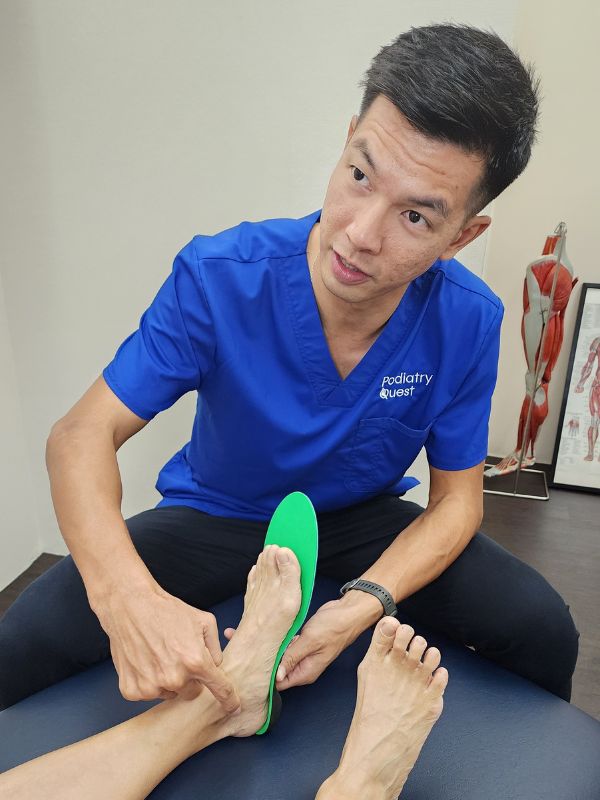
A flat foot is a complex, three-dimensional musculoskeletal issue. At Podiatry Quest, our Senior Podiatrists perform a deep-dive assessment to answer the critical clinical questions that a simple retail foot scan cannot:
- Is it a tight Achilles tendon? A shortened calf muscle can “pull” the heel bone into a tilted position, forcing the arch to collapse as a compensatory move.
- Is it ‘Adult Acquired Flat Foot’ (PTTD)? This is a progressive weakening of the Posterior Tibial Tendon and Spring Ligament train. If left undiagnosed, it can lead to a total collapse of the foot structure that requires surgical intervention.
- Or is it a ‘Flexible Flat Foot’ that only collapses under weight? Many feet look normal while sitting but “pancake” the moment you stand or run. This dynamic instability is the leading cause of “unexplained” knee and hip pain.
Data-Driven Precision: The Runeasi Advantage
While a physical exam identifies the structure, our Runeasi 3D Gait Analysis identifies the function. We are the first clinic in Singapore to utilise Runeasi 3D inertial sensors to see what the human eye misses:
- Loading Symmetry: We analyse if your flat feet are causing you to shift your weight unevenly, which is the #1 predictor for future stress fractures and joint wear.
- Objective Validation: By combining our clinical MSK findings with 3D data, we provide a definitive diagnosis. You won’t just be told you have flat feet; you will see exactly how your feet and lower limbs are performing in real-time.
Paediatric Note: Growing Feet
A Note for Parents: Children’s Flat Feet
It is normal for children to have flat feet at an early age. This is due to the incomplete bone development, weak ligaments and low muscle tone in the early years. This gradually strengthens and improves over time as the child advances in age. Due to this, almost all children’s feet appear to be flat until they are 3-4 years old. Full development of the feet is achieved around the age of 9-10.
However, if your child is tripping frequently, tires easily during play, or complains of “growing pains” in their shins, a podiatry assessment is recommended. Early intervention ensures their musculoskeletal system develops with the correct alignment.
If the answer is yes to any of the questions below, it is worthwhile to schedule an appointment to see us for a thorough assessment:
- Does your child have pain in the feet, legs or hips?
- Does your child complain of tired feet and legs that impairs their activities?
- Does your child trip or fall often while walking?
- Does your child’s foot shape and structure differ significantly between left and right feet?