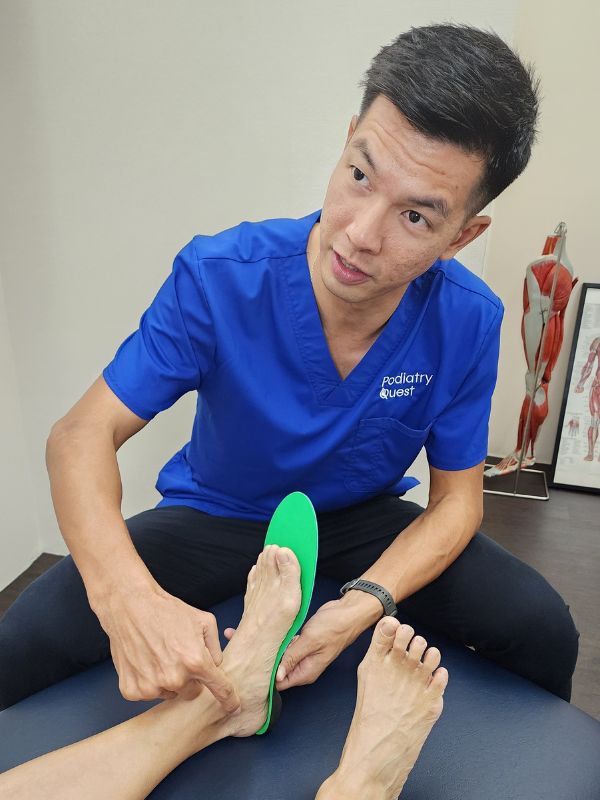
Treatment Options: Clinical Pathways
Effective podiatric management focuses on realigning rearfoot kinematics, supporting midfoot structures, and restoring load capacity to the dynamic leg muscles.
1. Customised 3D-Printed Foot Orthotics
The primary non-surgical intervention for flexible flat feet and adult-acquired collapse is precision biomechanical recalibration.
Following 3D optical foot scanning, our podiatrists prescribe customised 3D-printed foot orthotics. These medical-grade devices feature:
-
Inverted Rearfoot Posting & Calcaneal Cups: Deep heel cups that hold the calcaneus in a neutral position, stopping excessive inward rolling right at initial heel strike.
-
Calibrated Medial Arch Profiles: Built with variable-stiffness polymers that support the midtarsal joints under full weight while retaining enough flex to act as a dynamic spring.
-
Medial Skives and Kinetic Wedges: Strategically direct ground reaction forces laterally, reducing the workload on the posterior tibial tendon and plantar fascia.
2. Extracorporeal Shockwave Therapy (ESWT) for Chronic Tendinopathy
When flat feet lead to chronic, painful posterior tibial tendonitis or concurrent plantar fasciitis, we integrate extracorporeal shockwave therapy. High-energy acoustic pulses are directed into the injured tendon or fascial insertion to stimulate cellular repair, encourage healthy collagen alignment, and provide targeted pain relief without injections.
3. Precision Custom Ankle-Foot Orthoses (AFO)
For advanced, unstable, or fixed Stage 3 flat foot deformities where standard insoles cannot adequately stabilise the ankle, our clinic designs precision custom Ankle-Foot Orthoses (AFO). These low-profile devices control both the foot and the ankle joint complex, preventing lateral impingement, managing pain, and restoring steady walking mobility.
Prevention and Daily Foot Health Management
While you cannot alter your fundamental bone structure, specific lifestyle habits keep the surrounding soft tissues strong and resilient:
-
Avoid Extended Barefoot Walking on Hard Floors: Minimise barefoot walking on hard apartment tiles or floorboards. Wear structured, supportive indoor sandals with built-in arch support.
-
Maintain Posterior Chain and Ankle Mobility: Tight calf muscles (gastrocnemius and soleus equinus) force the foot to pronate prematurely to clear the ground. Regular calf stretches keep the ankle moving smoothly.
-
Strengthen Intrinsic and Extrinsic Foot Muscles: Perform isolated intrinsic foot exercises—such as “short foot” drills, seated towel scrunches, and controlled single-leg heel raises—to build muscular support for the arch.
-
Select Stable, Structurally Rigid Footwear: Look for everyday trainers and work shoes with a firm heel counter (the back of the shoe should not collapse under thumb pressure), torsional stability (the shoe should not wring like a towel), and a slight heel-to-toe drop.
Book Your Clinical Consultation at Podiatry Quest Singapore
Living with aching arches, tired feet, and compensatory lower limb strain is not something you have to tolerate. Whether you need diagnostic 3D gait mapping, custom 3D-printed orthotics, or specialised tendon therapy, our podiatry team delivers evidence-based, long-term care tailored to your movement needs.
Contact Podiatry Quest Singapore to schedule your comprehensive flat foot evaluation at our Novena, Raffles Quay, Harbourfront, Tampines, or Holland Grove clinics.