
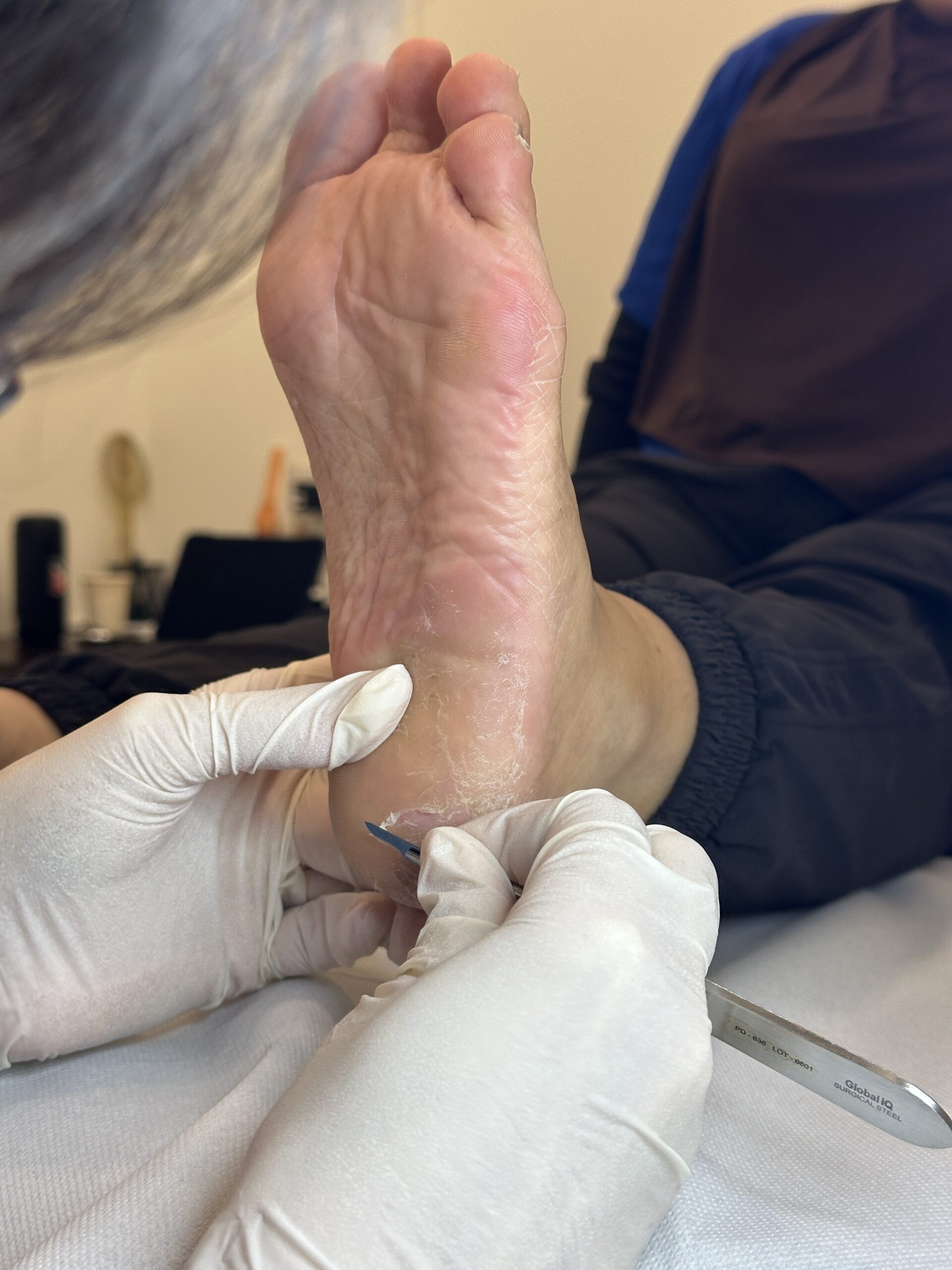
If you find yourself constantly filing your feet or applying “callus remover” acids only for the hard skin to return within a week, you aren’t failing at self-care. The reality we see daily at Podiatry Quest is that a callus isn’t a skin disease—it is a functional response.
In our clinics across Singapore—from Holland Grove to Novena—we treat patients who are active, fit, and diligent with their foot hygiene. Yet, the callus “bounces back” because the mechanical pressure or friction triggering the skin’s “armour” response remains unaddressed.
Callus vs. Corn: Identifying the Source of Pain
While people often use these terms interchangeably, they require different clinical approaches. A callus is generally a broad, flat patch of thickened skin found on high-load areas like the heel or the ball of the foot. Its purpose is protection, not comfort.
A corn, however, is more localised. It often feels like a sharp “core” or a pebble in your shoe, typically forming over a bony prominence or between the toes. If the pain is sharp and pinpointed, you are likely dealing with a corn that requires professional debridement rather than just a foot file.
The Problem With Modern “Callus Removal”
Most at-home treatments focus exclusively on the symptoms—thinning the skin. However, if the underlying biomechanics aren’t corrected, the skin will simply thicken again to protect itself. In our clinical experience, “callus bounce-back” is usually driven by:
Footwear Friction: Narrow toe boxes in dress shoes or stiff seams in casual trainers.
Gait Mechanics: A foot that over-pronates (rolls in) or a stiff big toe joint that forces weight onto the smaller metatarsals.
Structural Changes: Bunions or clawed toes that alter how your foot strikes the ground.
A Clinical Guide to Managing Thickened Skin at Home
If your calluses are mild and you do not have underlying health conditions like diabetes or poor circulation, you can manage them safely with a conservative routine by following these 3 tips:
1. Soften Before You Smooth
Avoid filing dry, “cold” skin. Soak your feet in warm water for 10 minutes first. This makes the keratin easier to manage and reduces the risk of accidental cuts.
2. Use a “Less is More” Approach with Filing
The goal is to smooth the area, not to remove the callus entirely. If you file until the skin is pink or raw, your body will respond by producing even thicker skin to compensate for the “injury.”
3. Choose “Keratolytic” Moisturisers
Standard body lotion isn’t enough for the soles of the feet. Look for creams containing Urea or Lactic Acid. These ingredients don’t just hydrate; they actively help break down the excess keratin bonds in thick skin.
When to See a Podiatrist
At Podiatry Quest, a consultation isn’t just about “buffing the skin.” We look at the “why.” Professional intervention is necessary if the callus is painful, cracking (fissures), or returning within a fortnight of home treatment.
For persistent cases, particularly those on the ball of the foot, we may use gait analysis to determine if customised foot orthotics are required. Unlike off-the-shelf inserts, these are prescription-only devices designed to offload specific high-pressure zones, effectively “telling” your skin it no longer needs to build up armour.
Local Insight: The Holland Grove Walking Pattern
We frequently see a specific pattern in the Holland Grove and neighbourhood areas: residents who walk significantly for daily errands in flat, unsupportive sandals or “fashion” sneakers. This repeated, low-grade friction is a primary driver for heel calluses. Simply rotating your footwear or choosing a wider toe box can often do more for your skin than months of filing.
Book a Clinical Assessment
Don’t spend years scraping away at a problem that has a mechanical solution. At Podiatry Quest, we confirm the diagnosis—ensuring it isn’t a wart or a corn—and provide a clear plan to stop the recurrence.
Contact Podiatry Quest
Locations: Holland Grove, Novena, Tampines, Harbourfront, Raffles Place
Phone: +65 6027 2389
WhatsApp: +65 8333 9643
